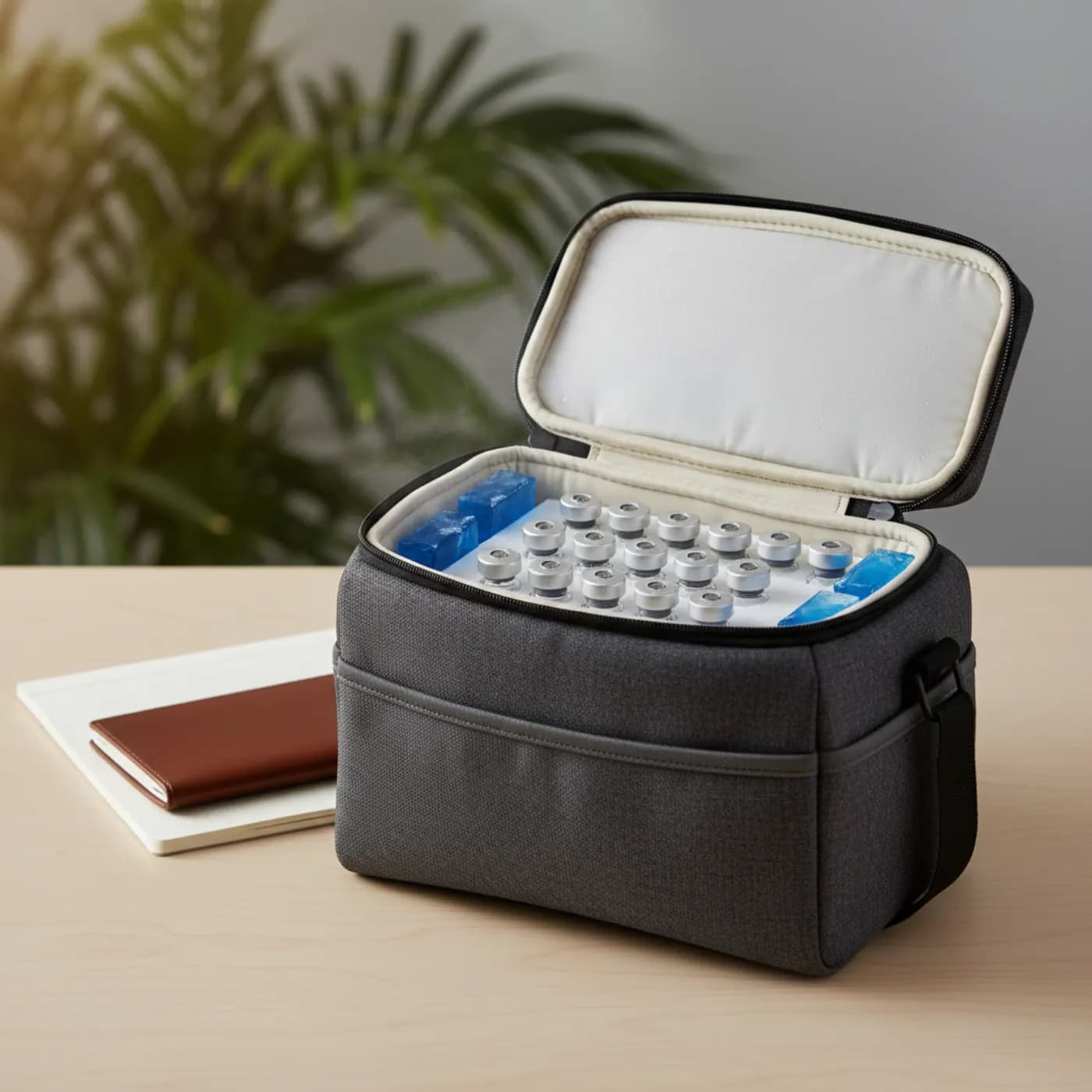
Cómo conservar y viajar con péptidos de investigación de forma segura
La conservación y el transporte de péptidos son un problema de cold-chain. Los viales lyophilized toleran brevemente el transporte a temperatura ambiente; los viales reconstituidos requieren 2–8 °C de forma continua. Las reglas prácticas para refrigeración, transporte aislado y aduanas.
Los péptidos de investigación son compuestos biológicos sensibles a la temperatura. Una conservación inadecuada los degrada — a veces de forma silenciosa, a veces catastrófica — y la mayoría de los informes de tipo "el péptido no funcionó" se remontan a una manipulación incorrecta más que al compuesto en sí.
Esta guía cubre las reglas prácticas para conservar, transportar y viajar con péptidos de investigación, distinguiendo lo que realmente importa del folclore excesivamente cauteloso.
El problema de los dos estados: lyophilized vs reconstituted
Los péptidos se distribuyen en dos estados físicos distintos, cada uno con sus propias reglas de conservación:
Lyophilized (polvo liofilizado) — la forma estándar de envío. El péptido se encuentra en un estado sólido estable con la mayor parte del agua eliminada. Los péptidos lyophilized son notablemente tolerantes a las variaciones de temperatura, porque la deshidratación detiene las reacciones químicas que impulsan la degradación.
Reconstituted (en solución) — una vez añadida bacteriostatic water, el péptido está en solución y el efecto protector de la deshidratación desaparece. Los péptidos reconstituidos son biológicamente activos pero químicamente frágiles.
Las reglas de conservación y transporte difieren drásticamente entre ambos estados. Consulte nuestra [guía del protocolo de reconstitución](/blog/how-to-reconstitute-lyophilized-peptides) para conocer el procedimiento de conversión en sí.
Temperatura de conservación: lo que la investigación realmente exige
| Estado | Conservación a largo plazo | Tolerancia a corto plazo | Transporte |
|---|---|---|---|
| Lyophilized | -20 °C ideal, 2–8 °C aceptable | Hasta 30 días a temperatura ambiente | Aislado, sin hielo en la mayoría de casos |
| Reconstituted | SOLO 2–8 °C | <24 horas a temperatura ambiente | cold-chain obligatoria |
Los péptidos lyophilized a -20 °C mantienen la estabilidad durante 12–24 meses según el compuesto. La mayoría de los estudios publicados de estabilidad de péptidos toman -20 °C como referencia a largo plazo. Un congelador estándar es suficiente; un congelador no-frost es suficiente; un arcón congelador para almacenamiento masivo funciona. Evite los ciclos frecuentes de freeze-thaw — extraiga solo lo que necesite.
Los péptidos lyophilized a 2–8 °C (refrigerador estándar) son aceptables para conservación a más corto plazo (3–6 meses) o para viales en rotación activa. La estabilidad inherente del estado lyophilized tolera la temperatura más alta.
Los péptidos reconstituidos deben mantenerse a 2–8 °C. Punto. La ventana útil de 30 días que recomendamos es el extremo conservador de los datos de estabilidad publicados con bacteriostatic water como diluyente. Con agua estéril (sin conservante), la ventana se reduce a 48 horas.
Lo que realmente degrada los péptidos
Los cuatro mecanismos de degradación de péptidos, en orden de frecuencia con la que causan problemas reales:
- 1Hidrólisis — el agua escinde los enlaces peptídicos. Por eso los péptidos lyophilized duran mucho más que los reconstituidos; sin agua, la reacción no puede avanzar. Los péptidos reconstituidos se hidrolizan lentamente a 2–8 °C, más rápido a temperatura ambiente, muy rápido por encima de 30 °C.
- 1Oxidación — los residuos de methionine y cysteine se oxidan al contacto con el aire. Una vez que el tapón de goma ha sido perforado repetidamente, la oxidación se acelera. Por eso recomendamos volúmenes pequeños por extracción y minimizar las punciones del tapón.
- 1Agregación — péptidos que se aglomeran en formas insolubles. Provocada por la agitación agresiva (por eso decimos "hacer girar, no agitar" durante la reconstitución) y por los ciclos de freeze-thaw en solución.
- 1Contaminación microbiana — crecimiento bacteriano o fúngico. La bacteriostatic water (con 0,9 % de benzyl alcohol) lo suprime; el agua estéril sin conservante no. Esa es toda la razón por la que recomendamos bacteriostatic water para cualquier péptido reconstituido conservado más de 48 horas.
Lo que NO degrada los péptidos de forma significativa:
- Exposición breve a la luz (los péptidos no suelen ser fotosensibles a las longitudes de onda de la iluminación interior normal)
- Calentamiento breve durante el tránsito (los péptidos lyophilized lo toleran bien)
- Vibración durante el envío (los péptidos no son frágiles en sentido mecánico)
Transporte aislado: lo que realmente necesita
Para enviar o trasladar péptidos lyophilized:
- Bolsa aislada estándar + acolchado de espuma: suficiente para tránsitos de menos de 24 horas
- + pequeño bloque refrigerante reutilizable (sin contacto directo): extiende con seguridad hasta 48 horas
- + packs de phase-change material: extienden a 72+ horas, útiles para flete aéreo internacional
Para péptidos reconstituidos en tránsito:
- Deben mantenerse 2–8 °C en todo momento — no es negociable
- Los bloques de hielo congelados en contacto directo congelarán la solución peptídica — lo cual es BAD (la formación de cristales de hielo daña el péptido). Use bloques de refrigerador, no de congelador, y manténgalos sin contacto directo con el vial.
- Tiempo máximo recomendado en tránsito: 24 horas. Para tránsitos más largos, envíelos lyophilized y reconstitúyalos en destino.
Viajes y aduanas: las reglas prácticas
Viajar con péptidos de investigación es legal en la mayoría de jurisdicciones cuando los compuestos están claramente destinados a fines de investigación / análisis de laboratorio — pero las consideraciones prácticas importan tanto como las legales.
*Para viajes en avión:*
- Mantenga los péptidos en su embalaje original sellado con la documentación
- Los péptidos lyophilized van en el equipaje de mano (la temperatura de cabina es más estable que la bodega de carga)
- Los péptidos reconstituidos van en el equipaje de mano con bolsa nevera aislada y bloques refrigerantes (la TSA y la mayoría de autoridades internacionales permiten líquidos médicos / de investigación con declaración)
- Lleve una copia del certificado de análisis y la especificación del producto — esto acredita la clasificación como reactivo de investigación
*Para envíos internacionales:*
- La forma lyophilized cruza fronteras de manera mucho más limpia que la reconstituida
- Algunas jurisdicciones (Asia-Pacífico, Oriente Medio) requieren declaraciones de investigación específicas en el formulario aduanero
- Consulte nuestra [guía de regulaciones UE + asiáticas](/blog/eu-asian-regulations-research-peptides) para reglas específicas por jurisdicción
*En casa / laboratorio:*
- Refrigerador estándar (2–8 °C) para la rotación activa
- Congelador estándar (-20 °C) para la conservación a largo plazo en estado lyophilized
- Evite conservar en la puerta (la temperatura fluctúa) — el fondo del estante es más estable
- No conserve junto a alimentos de olor fuerte (los tapones de goma pueden absorber olores con los meses)
Errores comunes de conservación
Recongelar péptidos reconstituidos — el error individual más dañino. La formación de cristales de hielo rompe la estructura peptídica. Una vez reconstituido, nunca lo congele.
Exposición directa al sol durante el tránsito veraniego — incluso una breve exposición directa al sol puede empujar las temperaturas superficiales por encima de los 50 °C. Las bolsas aisladas resuelven esto.
Agitación agresiva en lugar de hacer girar — tratado en la guía de reconstitución pero conviene repetirlo: agitar provoca agregación, no una disolución más rápida.
Punciones repetidas del tapón — cada inserción de aguja introduce oxígeno y riesgo de contaminación. Planifique sus extracciones para minimizar las punciones; considere transferir a varios viales más pequeños si realiza investigaciones prolongadas.
Confiar en la sensación intuitiva de "se notó cálido en tránsito" — el seguimiento real de temperatura mediante indicadores de cold-chain es mucho más preciso que la percepción, sobre todo en casos límite. Para compuestos críticos para la investigación, un [USB temperature logger](https://en.wikipedia.org/wiki/Data_logger) es un seguro barato.
Cuándo considerar un péptido dañado
Señales visuales de degradación del péptido:
- Turbidez o partículas en la solución tras la reconstitución → probable hidrólisis o contaminación, no usar
- Cambio de color inesperado (la mayoría de los péptidos se reconstituyen a soluciones claras e incoloras; los tonos amarillos o ámbar indican degradación en la mayoría de los compuestos)
- Moho visible o biofilm → contaminación microbiana, descartar
- Sin cambio visible pero el péptido se conservó por encima de 30 °C durante un período prolongado → potencia probablemente reducida, pero no necesariamente actividad nula. Para investigación donde la dose-response es relevante, reemplazar.
Referencia rápida
Para la mayoría de los investigadores, las reglas prácticas se reducen a:
- 1Lyophilized → congelador (-20 °C) o refrigerador (2–8 °C), envíelo/transpórtelo en bolsa aislada
- 2Reconstituted → SOLO refrigerador, nunca congelar, máximo 30 días con bacteriostatic water
- 3En tránsito → aislado + bloque refrigerante (sin contacto directo), declarar para cruces de frontera internacionales
- 4En caso de duda → considerarlo potencialmente comprometido y reemplazar para cualquier investigación cuyo punto final sea la dose-response
Prácticas de conservación resumidas a partir de la literatura publicada sobre estabilidad de péptidos y los SOP estándar de investigación farmacéutica. Los compuestos discutidos son reactivos químicos exclusivamente para investigación de laboratorio.
Continue Reading
All articles




All products referenced are chemical reagents for laboratory analysis. See our Terms & Conditions.